
Combat sports pack sponsorship into cage LED ribbons, mat centre marks, corner pads, and apron boards that fighters and camera crews constantly occlude. Sponsorlytix measured those surfaces for partners such as BKFC with combat-specific geometry and motion models.
Eagle Eye treated the cage as a cylindrical inventory surface and the mat as a planar one, then fused detections across handheld and fixed cameras. Brand Detection and Placement Detection keep bout-phase metadata on every exposure so promoters report fulfilment by walkout, stand-up, ground, and decision packages.
Problem framing for rights holders and brands
Cage LEDs wrap around the structure and disappear behind posts, fighters, and referees. Mat logos take heavy occlusion during grappling and ground exchanges. Standard planar detectors miss wrap-around LED segments and over-credit frames where the creative is barely readable.
Combat rights holders sell inventory against fight cards, not ninety-minute halves. Brands expect bout-level and round-level reconciliation. Without geometry-aware measurement, a single wide cage shot can invent exposure that never reached a readable state.
- Cylindrical unwrap is required for cage LED ribbons; planar assumptions fail at posts.
- Fighter and referee segmentation must drive occlusion masks before visibility scoring.
- Between-round packages spike corner-pad and apron inventory that open-fight cameras miss.
- BKFC-style cards need the same ontology as MMA and boxing ring apron boards.
Methodology — cage unwrap, occlusion, HITL
Cage post landmarks initialise a cylindrical unwrap for LED ribbons. Detectors run on the unwrapped strip and map back to image coordinates for reporting. Mat marks use planar homography from corner pads and painted lines. Occlusion masks from fighter and referee segmentation down-weight covered pixels before visibility scoring.
Round and bout metadata attach every exposure to the correct fight-card segment. Ambiguous creatives — sweat glare, blood on mat logos, motion-blurred LED segments — escalate to HITL. VLM passes assist identity when wrap-around crops split a brand string across posts. Results surface in Eagle Eye dashboards via Koba for ops sign-off.
Apron and corner-pad inventory often lives in between-round packages that open-fight detectors never see. Bout-phase clocks from the fight-card feed gate those detectors so walkout and decision packages get their own measurement windows.
Detection panels — LED and kit marks on real sports frames
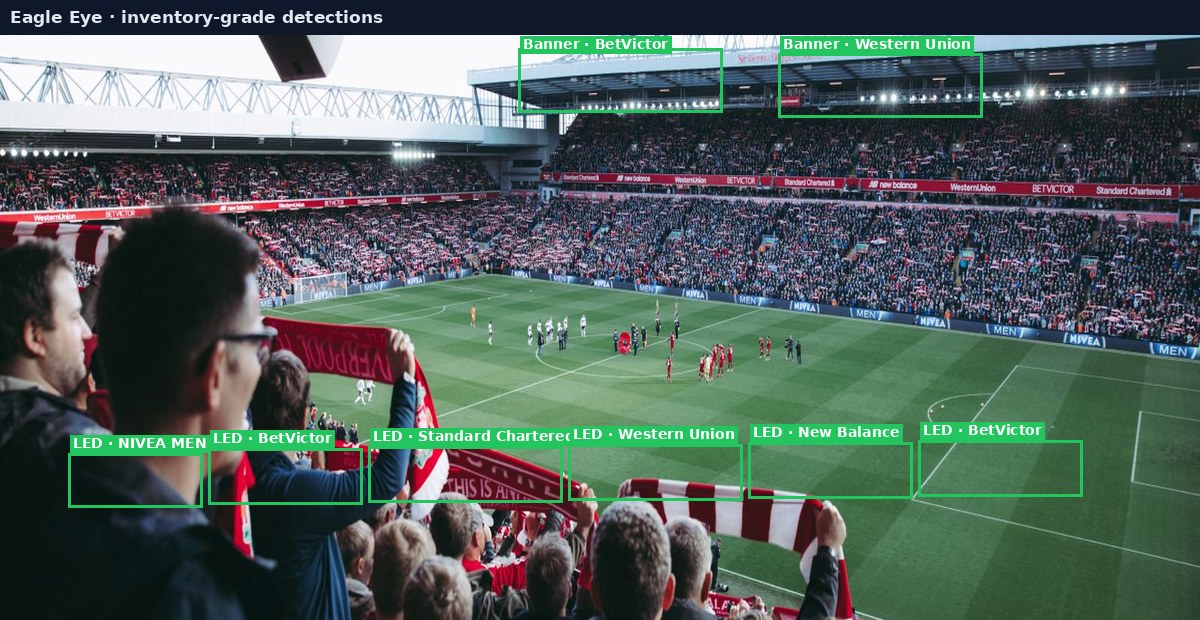
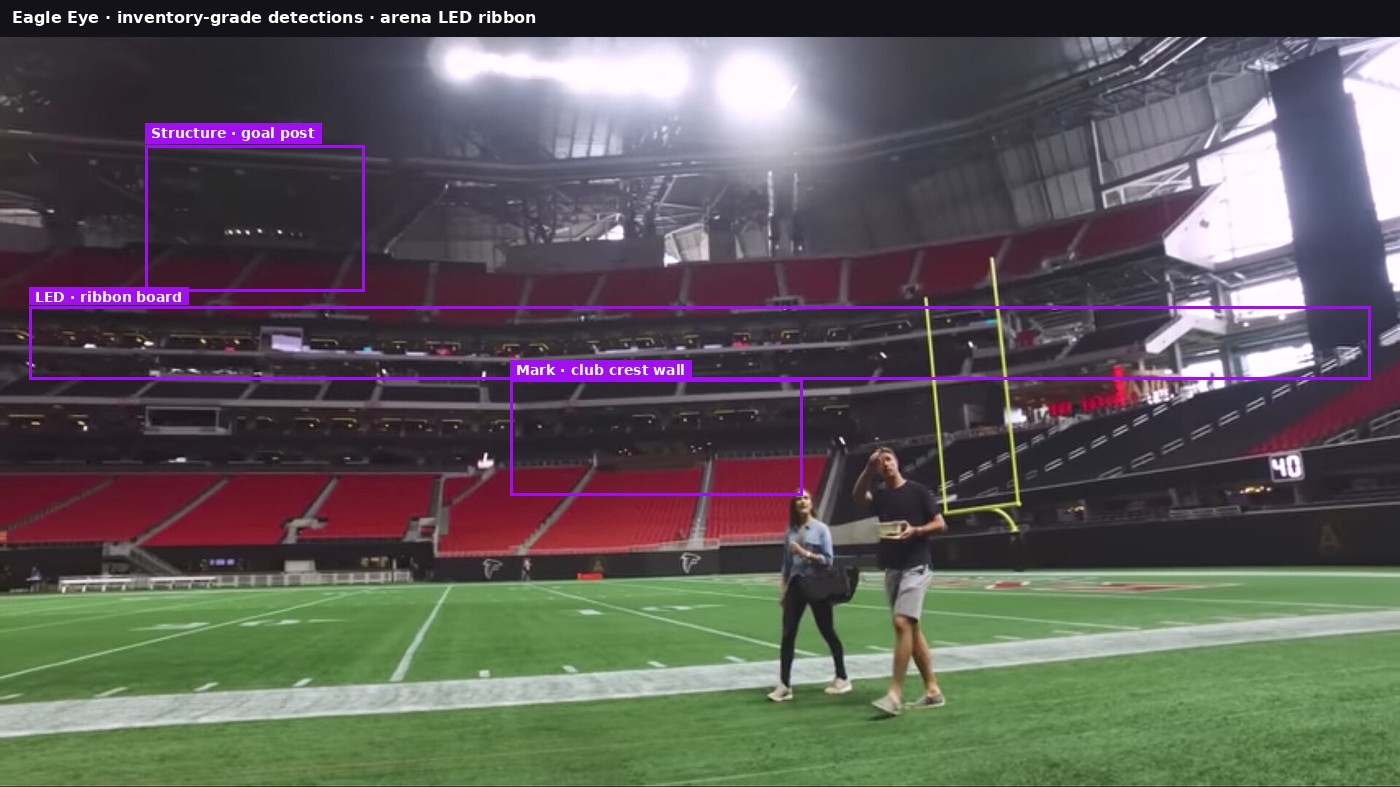
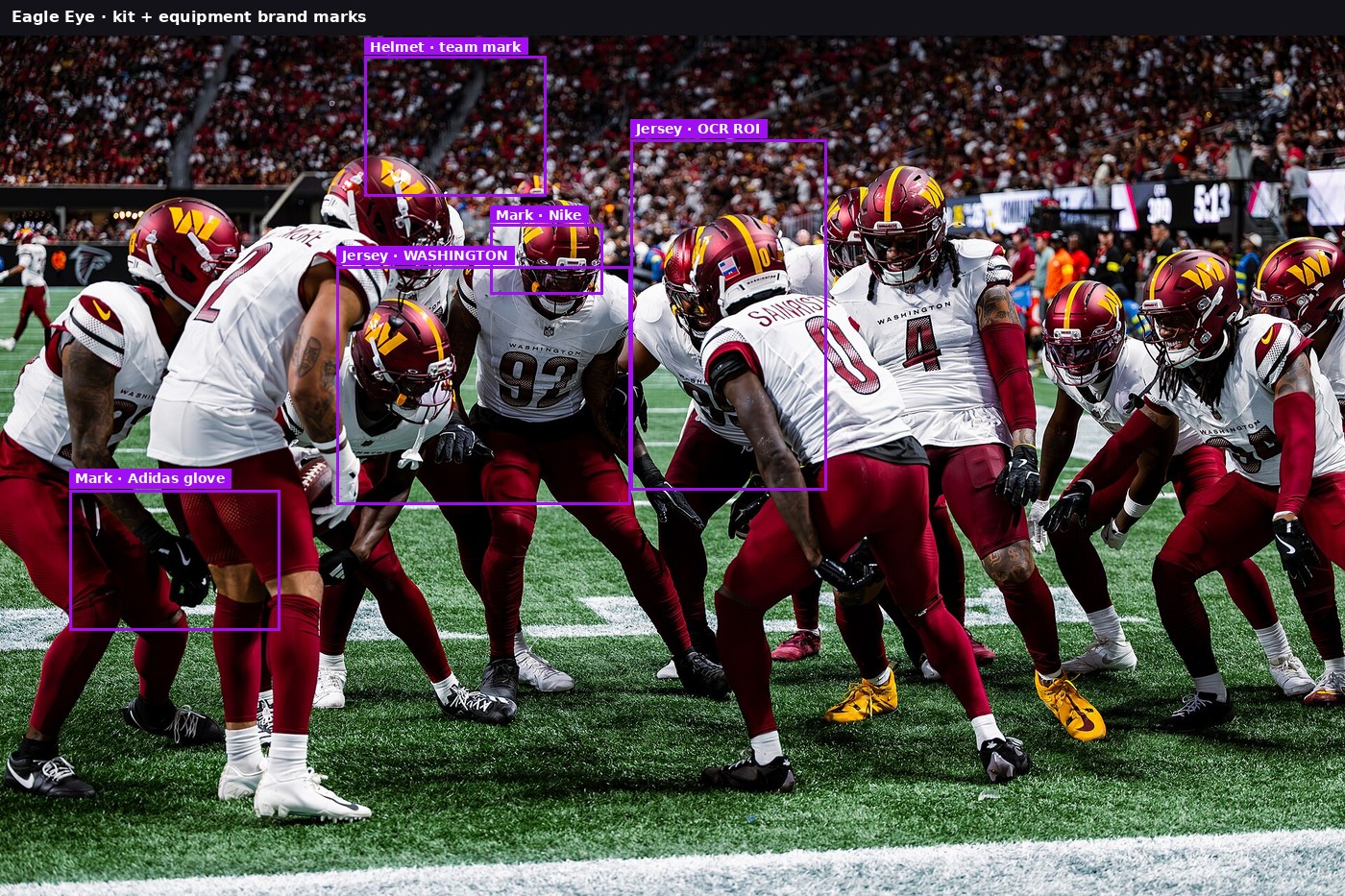
Combat-specific cage close-ups are sparse in the reusable org still library. The panels below apply the same inventory-grade detection grammar to perimeter LED ribbons and kit/equipment marks — the surfaces combat broadcasts share with other arena sports — and are captioned for cage/ring measurement methodology.
Real-world combat examples
- Cage LED ribbons during stand-up exchanges under fixed corner cameras.
- Mat centre logos during grappling sequences with partial fighter occlusion.
- Corner pad brands during between-round packages.
- Apron boards framed on walkouts and decision announcements.
- Glove and trunk marks in extreme close-ups that still carry contracted kit sponsors.
Results discussion (illustrative)
LED ribbon exposure concentrates in stand-up rounds. Mat marks contribute more when fights hit the ground. Sponsorlytix separates those patterns so combat rights holders report inventory by bout phase.
Code — cylindrical unwrap and bout tagging
def unwrap_cage_led(frame, posts, bands=64):
    """Map cage LED pixels into a cylindrical strip (illustrative)."""
    strip = []
    for b in range(bands):
        theta = (b / bands) * 2 * 3.14159
        col = sample_cylinder_column(frame, posts, theta)
        strip.append(col)
    return stack_columns(strip)

def tag_bout_exposure(detection, bout_meta, occlusion_mask):
    visible = detection.visibility * (1.0 - occlusion_mask.mean_in(detection.bbox))
    return {
        "brand_id": detection.brand_id,
        "asset": detection.asset_class,  # cage_led | mat | corner | apron
        "bout": bout_meta.bout_id,
        "round": bout_meta.round,
        "phase": bout_meta.phase,        # walkout | standup | ground | between | decision
        "visibility": visible,
    }
Takeaways
Combat sponsorship measurement needs cage unwraps, mat homographies, and fighter occlusion masks. Sponsorlytix shipped that stack for BKFC-style cards so every LED and mat mark lands on the exposure ledger.
Eagle Eye keeps fight-card timelines and inventory classes aligned for brands and promoters — with HITL guarding glare and wrap-around edge cases.