
Motorsport sponsorship rides on moving liveries and fixed trackside boards that appear for fractions of a second at race speed. Sponsorlytix measured both under circuit and onboard camera regimes so brands see exposure across the full coverage mix.
Eagle Eye tuned detectors for motion blur, specular carbon surfaces, and long-lens compression that collapses distant boards. Brand Detection and Placement Detection attach sector and camera metadata so title sponsors on the engine cover do not get confused with corner-board inventory.
Problem framing for rights holders and brands
A title sponsor on the engine cover may dominate onboard shots yet vanish on wide circuit pans. Trackside boards spike in specific corners and vanish elsewhere. Aggregate second counts without asset class and camera type mislead partners and undercut rate-card negotiations.
Series rights holders sell sector-aware and camera-aware packages. Brands expect onboard versus pit-lane versus corner splits. Measurement that cannot hold a blurry sidepod mark across three frames fails those packages.
- Livery pose estimates define nose, sidepod, rear-wing, and helmet ROIs.
- Trackside boards need circuit-map association when timing or GPS overlays exist.
- Temporal integration recovers brands a single blurred frame cannot resolve.
- Specular highlights on carbon and wet tarmac must not invent false positives.
Methodology — pose, maps, temporal fusion
Vehicle detectors and pose estimates define livery ROIs for nose, sidepod, rear wing, and helmet marks. Trackside boards use line-of-sight detectors keyed to circuit maps when telemetry or GPS overlays are available. Temporal integration across consecutive frames recovers brands that a single blurred frame cannot resolve.
Sector tags from timing data place exposures on the circuit layout. HITL reviews contested halo and helmet crops. VLM escalation helps when motion blur destroys template OCR on rotating LED gantries. Dashboards in Koba show sector heat and camera-type splits for commercial review.
Onboard cameras favour livery ROIs; corner cameras favour trackside boards. Placement Detection carries that camera prior into scoring so a title sponsor is not under-counted simply because the director spent a sector on scenery.
Wet-weather sessions amplify specular failure modes. Synthetic wet variants and active learning on live spray frames keep false positives from flooding the ledger when carbon mirrors the sky.
Detection panels — perimeter boards and kit marks
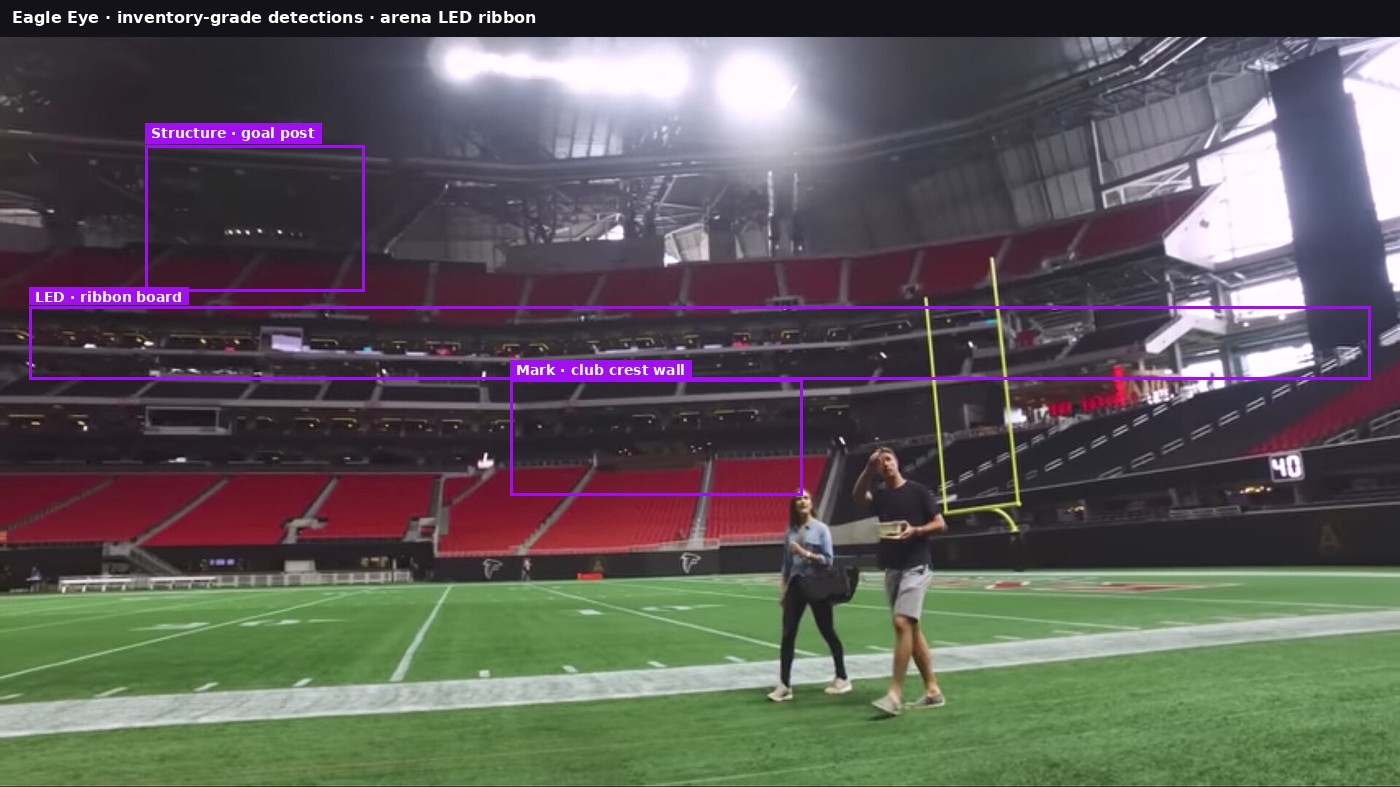
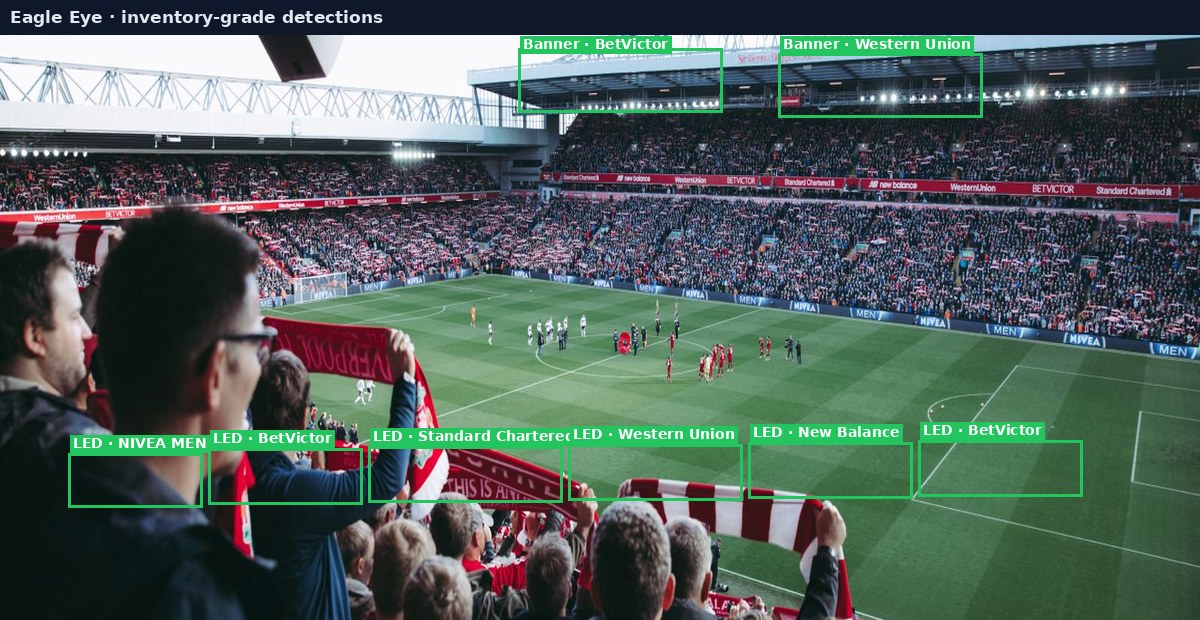
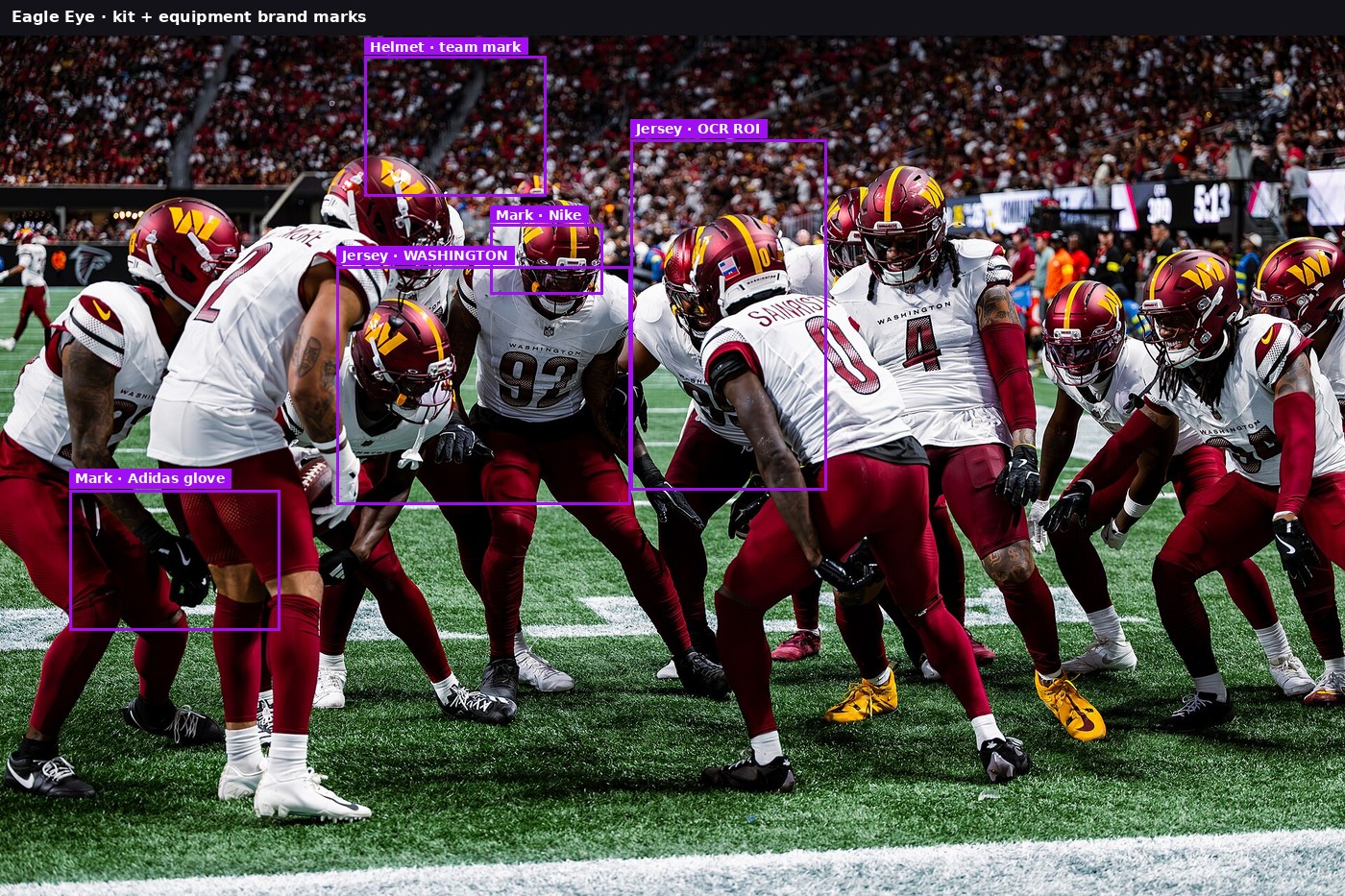
Race-car livery close-ups with clear org rights were limited in the reusable still set. Panels below use arena/stadium perimeter LED and kit-mark detections — the same Placement Detection grammar motorsport applies to trackside boards and helmet/suit marks — plus the gold stadium LED panel for high-density board scenes.
Real-world motorsport examples
- Sidepod and rear-wing marks on onboard and follow-car shots.
- Trackside LED and static boards on high-speed corner cameras.
- Pit-lane boards during stops and grid packages.
- Helmet and halo brands on driver close-ups.
- Gantry LED creatives that rotate between practice and race sessions.
Results discussion (illustrative)
Onboard packages concentrate livery exposure. Corner cameras lift trackside boards. Sponsorlytix reports both so motorsport rights holders reconcile inventory against the coverage plan that actually aired.
Code — sector aggregation
type MotorExposure = {
  brandId: string;
  asset: "livery" | "trackside" | "pit" | "gantry";
  camera: "onboard" | "corner" | "pit" | "aerial";
  sector?: string;
  visibility: number;
  clarity: number;
};

function bySector(events: MotorExposure[]) {
  return events
    .filter((e) => e.asset === "trackside" && e.sector)
    .reduce<Record<string, number>>((acc, e) => {
      acc[e.sector!] = (acc[e.sector!] ?? 0) + e.visibility * e.clarity;
      return acc;
    }, {});
}
def fuse_blurred_livery(track_frames, embedder, brand_bank):
"""Temporal embedding vote across consecutive blurred livery crops."""
votes = [embedder.nearest(brand_bank, f.crop) for f in track_frames]
brand_id, conf = majority_vote(votes)
return {"brand_id": brand_id, "conf": conf, "path": "temporal_embed"}Takeaways
Motorsport measurement succeeds when livery pose, trackside maps, and camera types stay linked. Sponsorlytix delivers that linkage so every blur-short brand still lands on the ledger.
Eagle Eye keeps circuit and onboard coverage on one sponsorship timeline for series and brand partners.