
Tennis sponsorship lives on court surfaces, net tapes, umpire chair wraps, and backdrop walls that broadcast directors reframe constantly. Sponsorlytix measured these assets under WTA and ATP camera patterns so visibility reflects what viewers saw — not what inventory sheets promised on paper.
At events such as the WTA Makarska Open, Eagle Eye covered court-level sponsorship with the same measurement discipline used across Sponsorlytix sports deployments. Brand Detection and Placement Detection share one ontology across clay, hard, and grass packages.
Problem framing for rights holders and brands
A baseline camera holds court logos for long rallies. An aerial cut shrinks those logos and enlarges backdrop walls. Player walk-ons light up chair and walkway brands for seconds. Manual logging misses that cadence and flattens fulfilment into a single second count that contracts never meant to use alone.
Tournament organisers sell camera-aware packages: centre-court painted marks in baseline coverage, backdrop creatives during changeovers and challenges, net-tape brands on cross-court exchanges. Brands need reports that speak that language.
For tournament commercial teams, the cost of a missed backdrop creative during a long changeover package is not theoretical — it is a make-good conversation. Continuous vision closes that gap before the conversation starts.
- Court geometry changes with surface and camera height; homography must stay honest under zoom.
- Backdrop walls dominate aerial and changeover packages; court logos dominate baseline rallies.
- Temporary overlays and virtual graphics must be separated from painted inventory.
- Makarska-style regional WTA events share the same detector grammar as Grand Slam camera packs.
Methodology — court homography, camera roles, hybrid CV
Homography estimation aligns each frame to a court template when enough line features are visible. Brand detectors then run in both image space and court-projected space so painted logos stay measurable under pan and zoom. Backdrop and net-tape brands use image-space detectors with temporal smoothing.
A camera-role classifier tags baseline, aerial, and close-up shots so exposure reports break down by how directors covered the match. Visibility scoring applies the standard Sponsorlytix analytics factors. Low-confidence backdrop creatives escalate to VLM identity resolution; HITL confirms novel tournament sponsors before they hit partner dashboards in Koba.
Sponsorlytix Brand Detection remains responsible for localising the mark; Placement Detection assigns court versus backdrop versus net versus chair. Analytics factors then score each event so a sharp baseline court logo and a soft aerial backdrop do not look identical in the ledger.
When line features vanish under extreme zoom or player occlusion, the system falls back to image-space detectors with temporal smoothing rather than forcing a bad homography. That fallback is logged so ops can see when geometry was unavailable.
Detection panels — real tennis frames with boxes
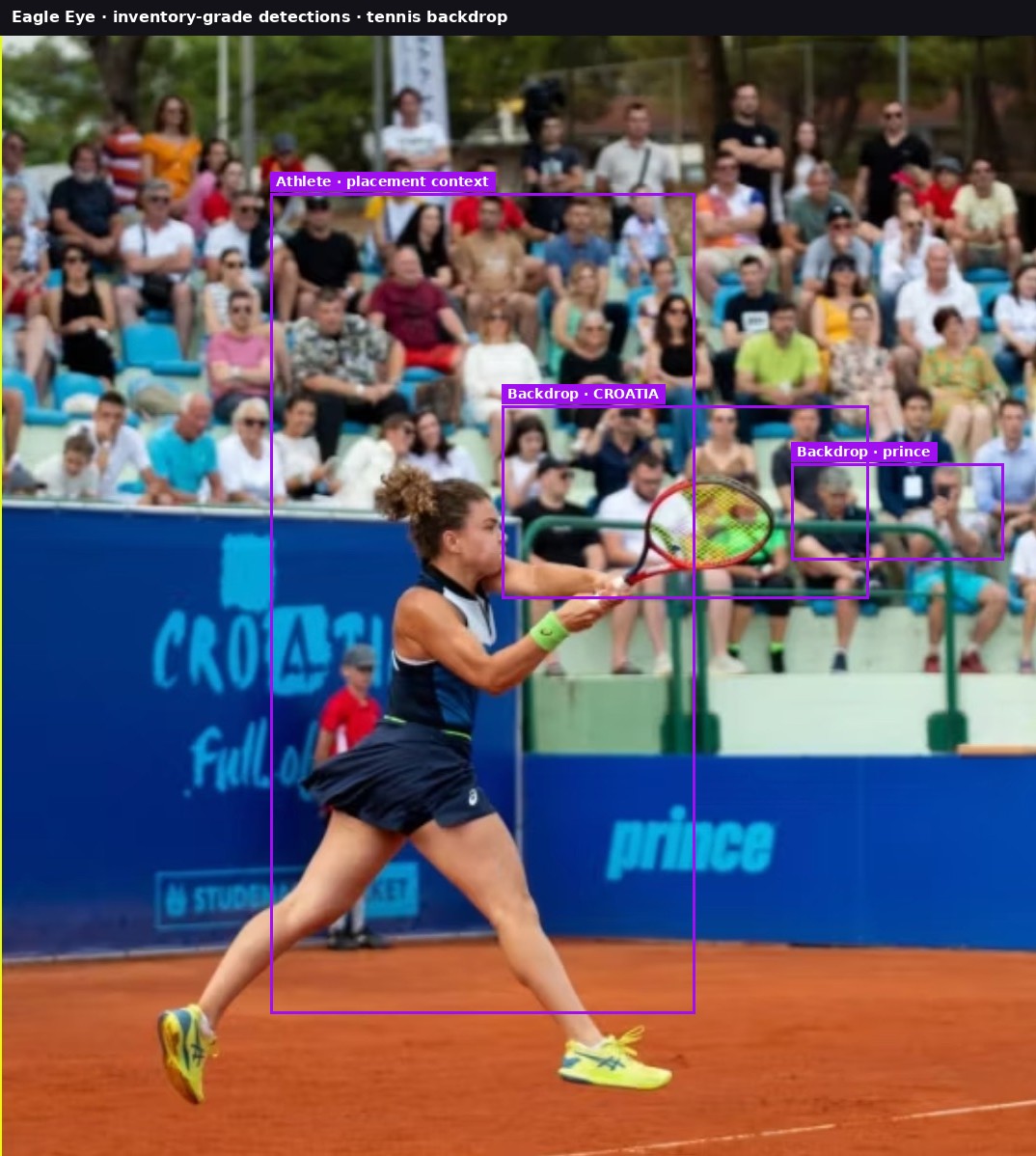
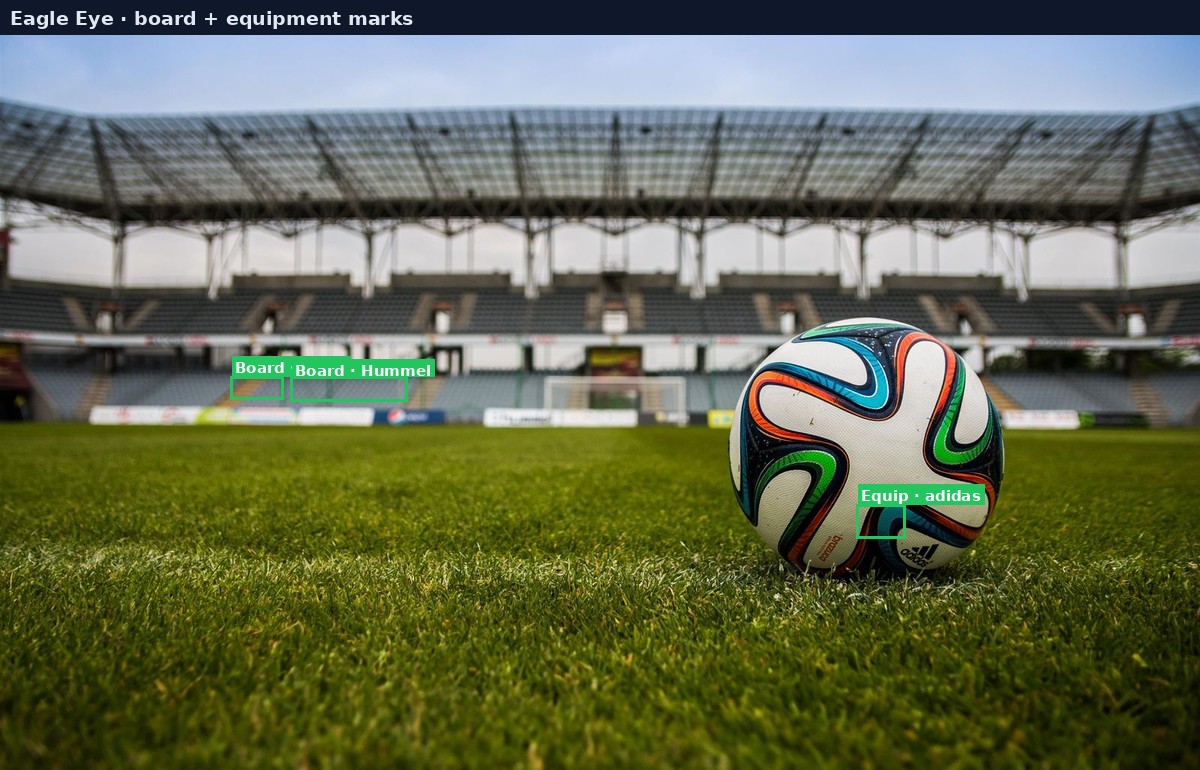
Real-world tennis examples
- Centre-court painted logos during baseline rallies on hard and clay surfaces.
- Backdrop wall creatives during changeovers and challenge reviews.
- Net-tape brands visible on cross-court exchanges and serve replays.
- Umpire chair and walkway wraps during player entrances.
- On-court sponsor carpets framed in walk-on and trophy packages.
Results discussion (illustrative)
Court logos dominate baseline packages. Backdrop inventory rises when directors cut wide or hold aerials. Sponsorlytix reports both so partners understand fulfilment by camera role rather than a single aggregate second count.
Code — camera-role accumulation
type TennisExposure = {
  brandId: string;
  asset: "court" | "backdrop" | "net" | "chair";
  cameraRole: "baseline" | "aerial" | "closeup";
  visibility: number;
  clarity: number;
  size: number;
};

function accumulateByRole(events: TennisExposure[]) {
  return events.reduce<Record<string, number>>((acc, e) => {
    const key = `${e.asset}:${e.cameraRole}`;
    acc[key] = (acc[key] ?? 0) + e.visibility * e.clarity * e.size;
    return acc;
  }, {});
}

function courtProjectedBox(bboxImg: number[], H: number[][]): number[] {
  // Map image-space box corners through homography H into court template space.
  return projectQuad(bboxImg, H);
}
def score_tennis_backdrop(track, camera_role, saliency):
"""Illustrative backdrop score conditioned on camera role."""
role_weight = {"baseline": 0.7, "aerial": 1.15, "closeup": 0.5}[camera_role]
attention = saliency.mean_in(track.bbox)
return track.dwell_sec * track.clarity * attention * role_weightTakeaways
Tennis sponsorship measurement needs court geometry and camera-role awareness. Sponsorlytix delivers both so WTA and ATP partners see inventory the way broadcast audiences experienced it.
Eagle Eye keeps court, net, chair, and backdrop assets on one reconciled timeline — ready for contract reconciliation and Koba review.